
RoleCraft ID theory
RoleCraft ID looks playful on the surface. Underneath, it is deliberately designed.
This page explains the thinking behind the framework: where it comes from, what it borrows, what it rejects, and why it’s structured the way it is. Not to persuade you—but to be clear.
If you want the complete breakdown, examples, and applications, the full explanation lives in the manual.
A Design Principle Up Front
RoleCraft ID is built on one core assumption:
People are most effective at work when their motivation, contribution, and context are aligned.
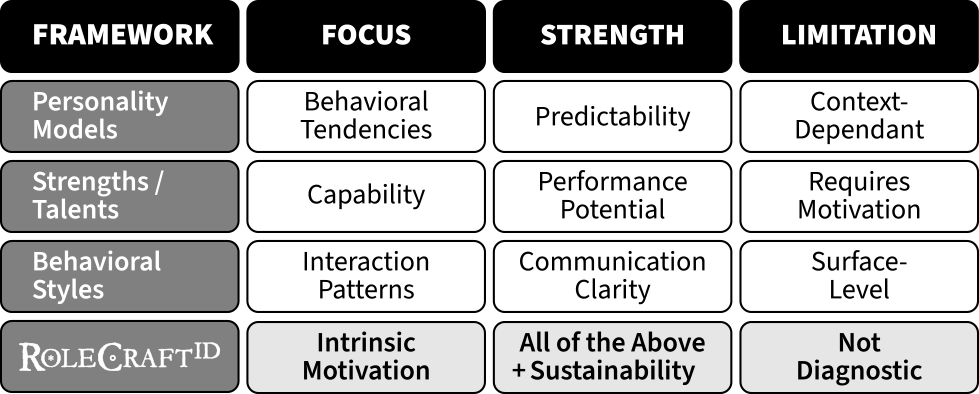
Most frameworks describe traits. RoleCraft focuses on function—what someone naturally does when responsibility, ambiguity, or pressure is present.
That distinction drives everything that follows.
Why Intrinsic Motivation Comes First
RoleCraft ID is grounded in Self-Determination Theory (SDT), a well-established framework in motivation research that shows people function best when their behavior is driven from within rather than managed through external pressure or rewards.
SDT shows that people are most motivated and effective when their work supports autonomy (choice), competence (mastery), and meaning through connection — rather than relying on control or external rewards.
Therefore, instead of asking:
What are you good at?
What type are you?
RoleCraft asks:
What do you feel internally compelled to do when something genuinely matters?
That question points directly to self-determination—the intrinsic motivations that shape attention, energy, and persistence, especially under pressure. These drivers tend to be more stable and predictive of behavior than preferences, talents, or personality traits.
The assessment is designed to surface patterns of motivation, not fixed identity.
The manual explains how this framework draws on SDT, why extrinsic incentives often degrade performance over time, and how intrinsic motivation is most evident when stakes are high.
Not Just another Personality Test
Personality models are helpful for description. They are less useful for decision-making.
Personality traits:
are broad
often context-dependent
and rarely tell you what to do next
RoleCraft ID avoids labeling people as types and instead maps roles of contribution—how someone tends to respond when something is misaligned, unclear, strained, or at risk.
This is why two people with very different personalities can share the same RoleCraft pattern—and why one person can express different roles in different contexts.
The manual goes deeper into the limitations of personality-based thinking and how RoleCraft avoids those traps.
Why Roles vs. Strengths or Talents
Strengths and talents matter—but only when they’re activated.
RoleCraft ID treats strengths as pattern markers and resources, not identity. A strength that isn’t intrinsically motivated or contextually appropriate often becomes a liability.
Roles answer a different question:
What responsibility do you instinctively take when something needs attention?
That makes roles easier to apply in:
leadership
teamwork
conflict
decision-making
The manual explores how overusing strengths leads to burnout and how role clarity prevents it.
Why Seven Roles
The seven roles in RoleCraft ID are not arbitrary.
They represent functional needs that show up in every durable human system, regardless of industry, culture, or era:
clarity
care
knowledge
momentum
stewardship
coordination
restoration
Different systems emphasize different roles at different times—but none function well without all of them.
RoleCraft does not claim these roles are exhaustive or exclusive. They are useful abstractions, chosen because they are:
stable
recognizable
and applicable across contexts
The manual walks through the logic of each role, its healthy expression, and its failure modes.
Why “Crafts” Exist at All
Roles describe what someone is motivated to contribute. Crafts describe how that contribution tends to show up in action.
Two people can share the same role and still look very different in practice. Crafts account for that variance without fragmenting the system.
They also prevent a common mistake: assuming a role dictates behavior.
The manual explains how Roles and Crafts interact, where tension arises, and how misalignment occurs.
Why Gamification
RoleCraft ID uses game-inspired elements from roleplaying and video games, not to trivialize work, but to improve engagement and recall.
Games work because they:
make roles explicit
clarify tradeoffs
surface consequences
and provide shared language
RoleCraft ID borrows those mechanics selectively:
character sheets
roles
progression
campaigns
There are no points for productivity theater. The goal is clarity, not play-acting.
The manual explains how to use these elements responsibly—and when not to.
Why Ancient and Biblical Language
RoleCraft ID uses role names that echo ancient and biblical language for three reasons:
These patterns predate modern organizations
The language is durable and memorable
The same functional roles appear across cultures, not just religious texts
This is not a religious framework.
No belief system is required.
No doctrine is taught.
The language is used as cultural shorthand, similar to how mythology or epic literature is often used to describe human behavior.
The manual addresses this explicitly, including the origins of the terminology and why it was chosen over modern corporate labels.
What RoleCraft ID Is Not
This framework is not:
a diagnosis
a prediction
a destiny
or a moral hierarchy
It does not tell you who you should be.
It gives you language to understand what you already tend to do—and how to do it more intentionally.
Misuse is possible. That’s why the framework emphasizes balance, context, and choice.
The manual includes an entire section on misuse, misinterpretation, and common failure modes.
Why the Manual Exists
The assessment introduces the system.
This page explains the thinking behind it.
The manual is where the framework becomes usable:
full role descriptions
development paths
team applications
scenarios
and practical guidance
If you want the complete theory, design rationale, and application details, the manual is where they live. Or feel free to contact us at any time >